Tag - India

World Water Day: Let’s reaffirm our pledge to save every drop of water, says PM Modi

On World Water Day, Prime Minister Modi said that the nation has taken several measures including Jal Jeevan Mission to ensure conservation of water and to give everyone access to clean drinking water.

“On World Water Day, let’s reaffirm our pledge to save every drop of water. Our nation is undertaking numerous measures like Jal Jeevan Mission to ensure water conservation and access to clean drinking water for our citizens,” tweeted PM Modi.

In another tweet PM Modi emphasized on how the Jal Jeevan Mission has proved to be extremely effective in making the lives of mothers and sisters easy.

“Jal Jeevan Mission is proving to be extremely effective in making the lives of mothers and sisters easier. With the participation of the people, the resolve to supply water from house to house will be fulfilled,” said Modi.

“Together, let’s further water conservation and contribute to a sustainable planet. Every drop saved helps our people and enhances our progress,” he tweeted.

World Water Day is observed on 22 March every year. It is an annual United Nations Observance, started in 1993, that celebrates water and raises awareness of the 2 billion people currently living without access to safe water. In 2022, the theme is spreading awareness about groundwater.

World Air Quality report 2021: Delhi most polluted capital city in the world

New Delhi has emerged as the most polluted capital city in the world, according to the latest World Air Quality Report for 2021. New Delhi is followed by Dhaka (Bangladesh), N’Djamena (Chad), Dushanbe (Tajikistan), and Muscat (Oman). The report found that no country met the World Health Organization’s (WHO) PM2.5.

India’s average pollution levels reached 58.1 µg/m3 in 2021, which ended a three-year trend of improving air quality.

“India’s annual average PM2.5 levels reached 58.1 µg/m3 in 2021, ending a three-year trend of improving air quality. India’s annual PM2.5 averages have now returned to pre-quarantine concentrations measured in 2019,” read the report.

According to the report, India was home to 11 of the 15 most polluted cities in Central and South Asia in 2021 and 48% of India’s cities exceeded 50 µg/m3 which is more than 10 times the WHO guideline.

“India was home to 11 of the 15 most polluted cities in Central and South Asia in 2021. Delhi saw a 14.6% increase in PM2.5 concentrations in 2021 with levels rising to 96.4 µg/m3 from 84 µg/m3 in 2020. No cities in India met the WHO air quality guideline of 5 µg/m3. In 2021, 48% of India’s cities exceeded 50 µg/m3, or more than 10 times the WHO guideline,” the report said.

Air pollution has a massive impact on human health in India. It is the second biggest risk factor for disease, and the economic cost of air pollution is estimated to exceed $150 billion dollars annually.

Major sources of air pollution in India include vehicular emissions, power generation, industrial waste, biomass combustion for cooking, the construction sector, and episodic events like crop burning.

It is estimated that 20% to 35% of total urban PM2.5 concentrations are directly or indirectly due to internal combustion engines in motor vehicles.

Australia to invest over $280 to boost cooperation with India

The Scott Morrison government has decided to invest over $280 million to boost cooperation with India, to further grow our economic relationship and support jobs and businesses in both countries, the Australian government said in a press statement on Tuesday.

In 2020, India was Australia’s seventh largest trading partner, with two-way trade valued at $24.3 billion, and sixth largest goods and services export market, valued at $16.9 billion. In 2020, India was Australia’s third largest market for services exports.

According to the press statement the Australia will provide additional investment in the relationship including $16.6 million to strengthen linkages with India’s key policy and finance institutions and $8.9 million to support enhanced business engagement and an increased Australian trade presence in India.

After the virtual meeting between Prime Ministers Morrison and Modi, Australia committed $17.2 million to extend the Australia-India Strategic Research Fund to continue supporting a world-class relationship and establish an Australia-India Innovation and Technology Challenge.

According to the Australian government statement, $35.7 million will be invested in a Green Steel Partnership, a Critical Minerals Research Partnership, and a contribution to the International Energy Agency to support cooperation on research, production and commercialisation of clean technologies, critical minerals and energy.

$25.2 million to expand the Australian Space Agency’s International Space Investment initiative to deepen space cooperation with India. Australia also allocated $28.1 million to launch a Centre for Australia-India Relations to deepen community ties, promote public discussions and policy dialogue, and engage the Indian diaspora.

Australia’s Minister for Trade, Tourism and Investment Dan Tehan said the Morrison Government was investing to grow the Australia-India economic, trade and investment relationship.

“India and Australia share common values, complementary economies and strong people-to-people links that make us ideal partners,” Mr Tehan said.

“The Government remains committed to the India Economic Strategy and its ambitious goals: to lift India into our top three export markets by 2035, and to make India the third largest destination in Asia for outward Australian investment,” he said.

“Australia’s Indian community is young and highly educated and well represented across services and STEM sectors with strong export potential,” Mr Tehan said.

He further said, “Indian diaspora networks can make important contributions to our trade and investment relationship with India, and also to Australia’s international competitiveness generally.”

India, US discuss mutual regional issues including Indo-Pacific, Ukraine situation

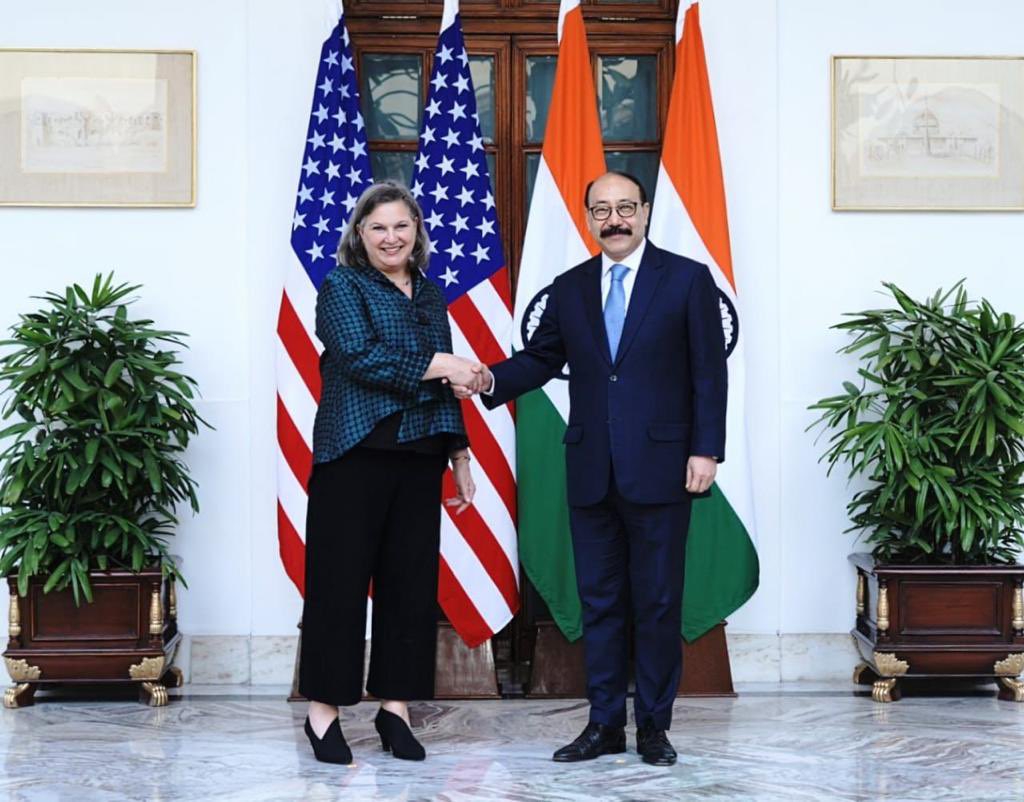
On Monday Foreign Secretary Harsh Vardhan Shringla and the U.S. Under Secretary of State for Political Affairs Victoria Nuland co-chaired India-US Foreign Office Consultations (FOC).

Two sides followed up on Prime Minister Narendra Modi’s discussions with President Joseph R. Biden in Washington D.C in September 2021, the two sides reviewed progress in various domains under the India-U.S. Comprehensive Global Strategic Partnership.

In the consultation both sides discussed issues regarding the situation in Ukraine. Developments in the South Asia, the Indo-Pacific region, West Asia were also discussed.

Both sides welcomed regular high-level dialogue and engagement, including productive meetings of bilateral mechanisms which led to intensifying of cooperation across all pillars of the bilateral agenda.

“The FOC provided a valuable opportunity to discuss contemporary regional issues pertaining to South Asia, the Indo-Pacific region, West Asia, and the situation in Ukraine, among others. Foreign Secretary Shringla and Under Secretary of State Nuland agreed to maintain regular dialogue and consultations on regional issues,” the Ministry of External Affairs said in a statement.

The two sides reaffirmed their commitment to a free, open, inclusive, peaceful and prosperous Indo-Pacific. They also followed up on Quad Leaders’ meeting and are eager to implement Quad’s positive and constructive agenda in Indo-Pacific region.

“Both sides reaffirmed their commitment to a free, open, inclusive, peaceful and prosperous Indo-Pacific. Following up on the Quad Leaders’ Meetings, they expressed a keen desire to implement quickly the Quad’s positive and constructive agenda to deliver for countries in the Indo-Pacific region,” the statement said.

Both sides agreed to work together to strengthen the India-US partnership regarding health security, climate actions and terrorism.

“Given their shared democratic values and convergences of strategic interests, Foreign Secretary Shringla and Under Secretary Nuland agreed to work together to strengthen the India-US global partnership regarding supply chains, critical technologies, health security, climate actions & clean energy and terrorism,” it said.

The statement said they noted the close cooperation between their two delegations at the UN Security Council, where India is currently a non-permanent member, and reiterated their desire to intensify cooperation in multilateral fora and international organisations, including the UN.

The statement further said, “Both sides looked forward to the India-U.S. 2+2 Ministerial Meeting in Washington D.C. They agreed to hold the next FOC at a mutually convenient date in Washington D.C.”

PM Modi, Morrison holds second India-Australia virtual summit; discusses about Russia-Ukraine war

Prime Minister Narendra Modi on Monday emphasised that peace and tranquillity at the border area is essential for normalisation of relations with the neighbouring country.

PM Modi made these remarks during the virtual summit with his Australian counterpart Scott Morrison. During the virtual summit the two leaders exchanged views on important regional and global issues.

Addressing a special media briefing on India-Australia virtual summit, Foreign Secretary Harsh Vardhan Shringla said, “Ukraine and China were discussed. On the Ukraine issue, it was clear that the two sides had referred to the Quad summit in which the leaders had a fairly clear perspective that the situation in Ukraine should not impact on the Indo-Pacific.”

Shringla said that both leaders discussed serious concerns about the ongoing conflict &humanitarian situation in Ukraine.

“Both leaders discussed serious concerns about the ongoing conflict &humanitarian situation in Ukraine & there was equal emphasis on the fact that International orders stand on the UN Charter on the rule of law and respect for the territorial integrity & sovereignty of states,” said Foreign Secretary Harsh Vardhan Shringla.

Employees Provident Fund Organisation adds 15.29 lakh net subscribers in January 2022

Employees Provident Fund Organisation (EPFO), added 15.29 lakh net subscribers during January 2022, up from 12.60 lakh in December 2021, according to the latest payroll data.

“The provisional payroll data of EPFO has been released today, i.e., 20th March 2022, which highlights that EPFO has added 15.29 lakh net subscribers during January 2022,” a labour ministry statement said on Sunday.

Month-on-month comparison of payroll data also indicates an increase of 2.69 lakh net subscribers addition in January, 2022 as compared to the net additions during the previous month of December, 2021.

Of the total 15.29 lakh net subscribers added during the month, around 8.64 lakh new members have been registered under the social security ambit of EPF & MP Act, 1952 for the first time.

Approximately 6.65 lakh net subscribers exited but re-joined EPFO by continuing their membership with EPFO instead of opting for final withdrawal. The payroll data also reflects a declining trend in the number of members exited since July, 2021.

According to the statement, age-wise comparison of payroll data shows that the age-group of 18-25 years has registered the highest number of net enrolments with 6.90 lakh additions during January 2022, which is around 45.11% of total net subscribers addition during the month. This is followed by the age-group of 29-35 years with a healthy addition of around 3.23 lakh net enrolments. This indicates that many first-time job seekers are joining organised sector workforce in large numbers and signifies a crucial stage for an individual’s potential in terms of earning capacity.

State-wise comparison of payroll figures highlights that the establishments covered in the states of Maharashtra, Haryana, Gujarat, Tamil Nadu and Karnataka are in lead by adding approximately 9.33 lakh subscribers during the month, which is around 61% of total net payroll addition across all age groups.

Gender-wise analysis indicates that net female payroll addition during the month is approximately 3.20 lakh during the month. Share of female enrolment is approximately 21% of the total net subscribers addition during the month of January, 2022 with an increase of 57,722 net enrolments over the previous month of December, 2021.

Industry-wise payroll data indicates that ‘expert services’ category (consisting of manpower agencies, private security agencies and small contractors etc.) constitutes 39.95% of total subscriber addition during the month. In addition, growing trend in net payroll additions has been noted in industries like Expert Services, Engineering Contractors, Trading (Commercial Establishments) and Building & Construction industry etc.


Ahead of PM Modi-Morrison Virtual Summit Australia Hands Over 29 Antiquities to India

Ahead of a virtual meeting between PM Modi and his Australian counterpart Scott Morrison, twenty-nine antiquities were repatriated to India by Australia on Monday.

PM Narendra Modi inspected the twenty-nine antiquities which have been repatriated to India by Australia.

The antiquities range in six broad categories as per themes: Shiva and his disciples, Worshipping Shakti, Lord Vishnu & his forms, Jain tradition, portraits & decorative objects. These antiquities come from different time periods, with earlier ones dating to the 9-10 century CE.

The antiquities that are repatriated to India by Australia represent a large geographical region in India. The antiquities are from Rajasthan, Gujarat, Madhya Pradesh, Uttar Pradesh, Tamil Nadu, Telangana, and West Bengal.


Reduce Sugar production and increase conversion to ethanol, says Nitin Gadkari

On Sunday while addressing the Sugar & Ethanol India Conference (SEIC) in Mumbai Union Minister for Road Transport and Highways, Nitin Gadkari gave a clarion call to the sugar factories to make a shift to the conversion of sugar into ethanol.

The Minister issued a warning to leaders of sugar and allied industries that if sugar production goes ahead as it does now, it will be harmful for the industry in times to come. Reminding them that as a country, we are rice-surplus, corn-surplus, and sugar-surplus, Gadkari said that what is good for our future is to reduce the production of sugar and increase the production of ethanol.

The Minister explained how the economics of ethanol is superior to that of vehicles run by diesel or petrol.

“We have issued advisory on flex engines; Toyota, Hundai and Suzuki have assured me that they will bring flex engines within six months. Recently, we launched pilot car run by green hydrogen. Toyota Chairman informed me that their car is flex – either 100% petrol or 100% ethanol and that Toyota cars of coming days will be run on hybrid electricity, which will generate 40% electricity and run 60% of the distance using 100% ethanol. This economics will be highly advantageous in comparison to petrol,” said Gadkari while addressing the SEIC.

The Minister exhorted all sugar factories whomanufacture ethanol to open ethanol pumps in their factories and other areas.

He said, “This can bring in 100% ethanol-run scooters, auto rickshaws and cars and thus increase ethanol consumption, reduce pollution, bring down imports and also provide jobs to people in villages.”

“There will definitely be a big enough market for Ethanol,” he further added.

The Minister assured that no one needs to be concerned whether there would be a big enough market for ethanol.

“Ethanol is a green and clean fuel; we are producing 465 crore litres of ethanol at present. However, when E-20 programme gets completed, our requirement will become around 1,500 crore litres. Moreover, in coming five years, when flex engines get ready, ethanol requirement will become 4,000 crore litres,” said Gadkari.

Hence, if you do not convert to ethanol and keep producing sugar, the factory will become loss-making, cautioned the Minister.

The Minister also said that the government is thinking of ways to increase the use of ethanol in the aviation sector and in the Indian Air Force.

“I am also exploring how to use ethanol in aviation industry. Two years ago, fighter jets which participated in Republic Day Parade had used 100% bio-ethanol. I am in discussion with Air Force Chief and Defence Ministry officials; we are thinking on how to increase use of ethanol in aviation and Indian Air Force,” the Minister added.

India’s maize exports reach an all-time high of $816.31 million

The export of maize has touched USD 816.31 million in the first ten months of current fiscal 2021-22 (April-January), already exceeding the USD 634.85 million achieved during the last financial year.

From an exports realization of USD 142.8 million in 2019-20, the export of maize increased nearly sixfold, taking the total value of shipment to USD 1593.73 million in the last three years despite logistical challenges posed by the COVID19 pandemic outbreak, according to a statement by Ministry of Commerce & Industry.

Neighbouring countries like Bangladesh and Nepal are the major importers of maize from India. Bangladesh has imported maize worth USD 345.5 million in the current fiscal (April-January), while Nepal has imported maize worth USD 132.16 million during this period.

Vietnam has emerged as a major destination for the export of maize. India exported maize worth USD 244.24 million to Vietnam in the first ten months of the current fiscal (April-January 2021-22). Other prominent importing countries are Malaysia, Myanmar, Sri Lanka, Bhutan, Taiwan, Oman, etc, the statement read.

Maize, which is globally known as the queen of cereals, has emerged as one of the significant foreign exchange-earners under the commodities covered under the Agricultural and Processed Food Products Export Development Authority (APEDA) ambit.

“The significant rise in agri-exports is seen as a testimony of the government’s commitment to increase farmers’ income through creating requisite infrastructure and improving value chains on boosting exports of agricultural and processed food products,” Dr. M. Angamuthu, Chairman, APEDA said.

Maize is the third most important cereal crop in India after rice and wheat. The cereal crop is primarily cultivated in the states of Karnataka, Madhya Pradesh, Kerala, Bihar, Tamil Nadu, Telangana, Maharashtra, and Andhra Pradesh.

India may soon top hate and anger charts, says Rahul Gandhi on Happiness report

On Saturday Congress leader Rahul Gandhi slammed the Centre over the country’s ranking in the latest World Happiness Report, saying India would soon top hate and anger charts.

Taking to Twitter, Rahul Gandhi shared the report and said, “Hunger Rank: 10, Freedom Rank: 119, Happiness Rank: 136. But, we may soon top the Hate and Anger charts!”

Published by United Nations Sustainable Development Solutions Network, the World Happiness Report ranks countries on several factors such as sense of well-being, GDP per capita, social support system, life expectancy, generosity, liberty to make life choices and perceptions of corruption, etc.

India ranked 136th in the World Happiness Report 2022.

Finland becomes the happiest country for the fifth consecutive year. Denmark bagged the second spot and Iceland claimed the third position in the report. Switzerland and Netherlands stood at fourth and fifth rank. Meanwhile, Luxembourg, Sweden, Norway, Israel, and New Zealand were the remaining countries in the top 10.

Among the South Asian nations, only Afghanistan fared worse than India as it was named the most unhappy country in the world, ranking last on the index of 146 countries.

Nepal (84), Bangladesh (94), Pakistan (121), and Sri Lanka (127) managed to get better ranks in the list.